

Product Overview
- Your digital files are available for immediate download after checkout. Each file may be downloaded up to two (2) times using the link provided in your order confirmation. We strongly recommend saving your files to your device and creating a backup copy for future access. Lost files or files that are no longer available for download must be repurchased.
- We offer our digital downloadable materials under two license options:
- an Individual License for individual homeschoolers, and
- Extended License for schools, school districts, co-ops, and multi-family homeschool groups.
- School Districts must purchase the extended license option.
Choosing the correct license helps us keep pricing affordable while also preventing copyright misunderstandings.
Montessori CVC Word Building, Phoneme Manipulation, and Early Phonics
What happens when a child discovers that changing just one sound—at the beginning or end of a word—can create an entirely new word?
Children may recognize the sounds in familiar words, but understanding how to manipulate those sounds is an important step toward becoming independent readers.
The ETC Montessori Science of Reading: Initial and Ending Letter Substitution Kit B helps children explore this concept through concrete, picture-supported word-building activities.
Designed for Montessori Early Childhood and beginning readers, this digital printable resource introduces initial and final phoneme substitution using simple consonant-vowel-consonant (CVC) words.
Children begin with a familiar word, identify the sound that must change, and select the corresponding lowercase letter to create a new word.
Unlike activities that focus exclusively on beginning sounds, Kit B challenges children to recognize changes at both ends of a word, strengthening their understanding of how individual sounds and letters work together.
What Is Initial and Ending Sound Substitution?
Phoneme substitution is the ability to replace one individual speech sound in a word with another sound to create a different word.
For example, consider the sequence:
cab → cat → mat → map → cap → can
Beginning with cab, the child replaces the final /b/ sound with /t/ to create cat.
Next, the child replaces the initial /k/ sound in cat with /m/ to create mat.
By continuing this process, the child discovers that a single sound change can alter a word's pronunciation, spelling, and meaning.
This progression encourages children to listen carefully and determine whether the changing sound occurs at the beginning or the end.
When students use written letters to represent these changes, they also strengthen phonics and their understanding of the alphabetic principle.
What Is Included in Initial and Ending Letter Substitution Kit B?
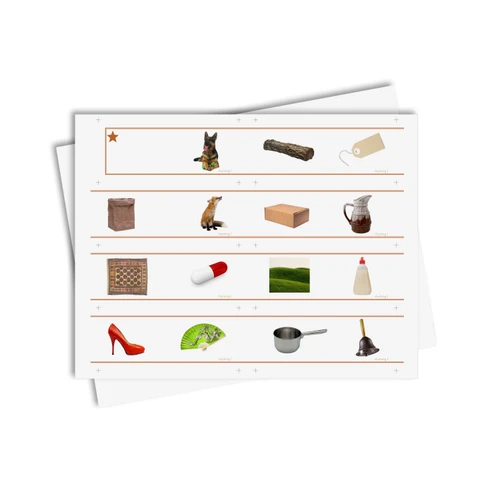
This seven-page digital printable provides 30 illustrated word examples organized into five short-vowel sequences.
Each sequence begins with a completed word and provides five additional picture-supported opportunities to substitute an initial or ending letter.
Short a
cab → cat → mat → map → cap → can
Short e
den → men → met → pet → pen → hen
Short i
tip → tin → fin → fig → dig → dip
Short o
tot → cot → cog → hog → hot → pot
Short u
rug → run → bun → bug → mug → mud
The printable also includes:
-
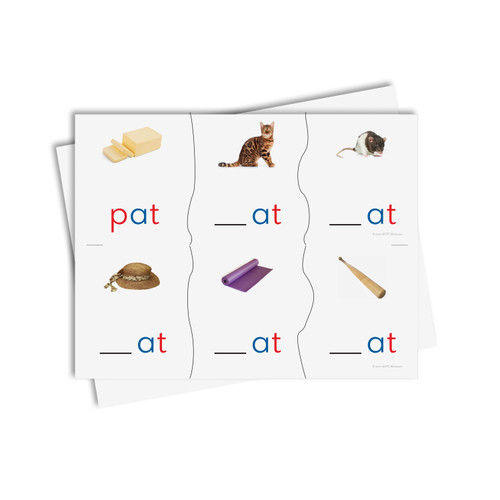
Picture-supported word cards with completed examples and missing letters
-
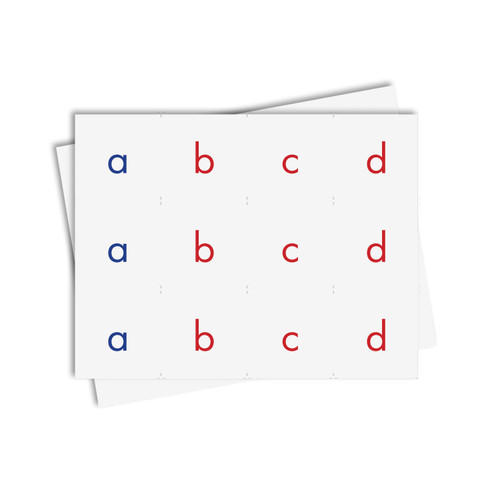
Lowercase letter pieces for initial and ending substitutions
-
An additional sheet of letters for preparing the activity
-
A reference page listing the word sequences and letters used
The vowel remains unchanged within each sequence, allowing children to concentrate on how changes to the beginning or ending consonant create different words.
How Does the Montessori Letter Substitution Activity Work?
The activity follows a logical progression that connects listening, observation, phoneme manipulation, and written language.
Step 1: Introduce the Starting Word
The guide or parent presents a completed CVC word, such as cab.
The child says the word aloud and identifies its individual sounds.
Step 2: Examine the Next Picture
The child observes the next picture and names the object or action it represents.
For example, the next picture may represent cat.
Step 3: Identify Which Sound Changes
The child compares the two words, listening for the difference.
In cab and cat, the beginning and middle sounds remain the same. Only the final sound changes.
Step 4: Replace the Letter
The child selects the appropriate lowercase letter and places it in the empty space to complete the new word.
Step 5: Continue the Word Sequence
The child moves to the next picture, where the changing sound may occur at the beginning rather than the end.
By repeating this process, children discover that words can be transformed through deliberate changes to individual sounds.
How Does Kit B Support the Science of Reading?
Phonemic awareness involves recognizing and manipulating individual sounds in spoken language.
Phonics connects those sounds with their written letter representations.
Initial and Ending Letter Substitution Kit B combines both skills in one purposeful activity.
Children must listen to the word, determine which phoneme changes, identify the replacement sound, and select the corresponding letter.
This encourages several foundational literacy skills:
Phoneme Isolation: Identifying individual sounds at the beginning and end of words.
Phoneme Substitution: Replacing one sound with another to create a new word.
Phoneme Segmentation: Recognizing that CVC words contain three individual phonemes.
Phoneme Blending: Combining the sounds in the completed word.
Letter-Sound Correspondence: Connecting spoken phonemes with written lowercase letters.
CVC Word Building: Applying knowledge of simple consonant-vowel-consonant patterns.
Early Decoding and Encoding: Strengthening the sound-letter relationships used in reading and spelling.
Because the pictures provide meaning and the printed letters provide a visual reference, children can explore sound changes through more than one form of representation.
What Makes Kit B Different From Kit A?
Both kits introduce children to the idea that changing a single sound can create a new word.
However, they develop different levels of phoneme manipulation.
Kit A – Initial Letter Substitution
Children change the beginning consonant while keeping the remainder of the word unchanged.
For example:
pat → cat → rat → hat
This introduces sound substitution through a predictable word-family pattern.
Kit B – Initial and Ending Letter Substitution
Children change either the beginning or ending consonant.
For example:
cab → cat → mat → map
Because the location of the changing sound varies, students must pay closer attention to the structure of each word.
Kit B therefore provides a natural extension for children who are ready to move beyond beginning-sound substitution.
Why Use Letter Substitution Activities in Montessori Education?
Montessori language education encourages children to explore spoken language before progressively connecting sounds with written symbols.
Initial and ending letter substitution activities give children opportunities to manipulate those symbols while investigating how words are constructed.
The material supports purposeful movement, careful listening, visual discrimination, and repetition.
The color-coded letters also provide a visual distinction between vowels and consonants, helping children recognize the structure of simple phonetic words.
As students gain confidence, they can begin making predictions about which letter will change and reading the completed words aloud.
This approach supports the transition from identifying sounds to building and decoding words independently.
A Practical Resource for Montessori Teachers and Homeschool Parents
For Montessori teachers, Kit B provides structured follow-up activities after presentations involving beginning sounds, ending sounds, Sandpaper Letters, and early phonetic word building.
The material can be introduced during individual lessons and later placed on the language shelf for additional practice.
For homeschool parents, the picture-supported format provides an approachable way to help children explore how changing one letter alters a word.
Parents can begin by practicing sound substitutions orally and then introduce the printed letters once the child is ready to connect sounds with written symbols.
The activity may also be useful for kindergarten instruction and targeted foundational literacy practice with children who need additional support recognizing and manipulating phonemes.
Who Is This Material Designed For?
Initial and Ending Letter Substitution Kit B is ideal for Montessori Early Childhood students, typically ages 3–6, kindergarten learners, homeschool families, phonemic awareness lessons, beginning phonics instruction, and CVC word-building activities.
It is particularly appropriate for children who already have experience identifying beginning and ending sounds and are ready to manipulate those sounds within simple words.
RESOURCES
Look at the standards that are addressed with this material.