Product Overview
- Your digital files are available for immediate download after checkout. Each file may be downloaded up to two (2) times using the link provided in your order confirmation. We strongly recommend saving your files to your device and creating a backup copy for future access. Lost files or files that are no longer available for download must be repurchased.
- We offer our digital downloadable materials under two license options:
- an Individual License for individual homeschoolers, and
- Extended License for schools, school districts, co-ops, and multi-family homeschool groups.
- School Districts must purchase the extended license option.
Choosing the correct license helps us keep pricing affordable while also preventing copyright misunderstandings.
Montessori Addition Operations and Math Facts for Ages 6–9
Adding numbers is easy to demonstrate. Helping a child understand why addition works is where meaningful mathematics begins.
Children develop a lasting understanding of addition when they can see quantities, manipulate materials, recognize patterns, and discover how numbers work together.
The ETC Montessori Lower Elementary Math Task Cards: Addition provide a comprehensive collection of printable mathematics activities designed to strengthen addition skills through purposeful, hands-on learning.
Created for Montessori Lower Elementary students ages 6–9 (grades 1–3), this digital resource combines addition operations and mathematical facts while connecting traditional Montessori presentations with the language students encounter in state standards and academic assessments.
Rather than relying exclusively on memorized answers or repetitive worksheets, these task cards encourage children to develop number sense, investigate mathematical relationships, and become confident, independent problem-solvers.
What Is Included in the Addition Task Cards?
The collection is organized into two areas of mathematical development: Addition Operations and Addition Facts.
Addition Operations
These activities provide follow-up work connected to traditional Montessori mathematics materials.
-
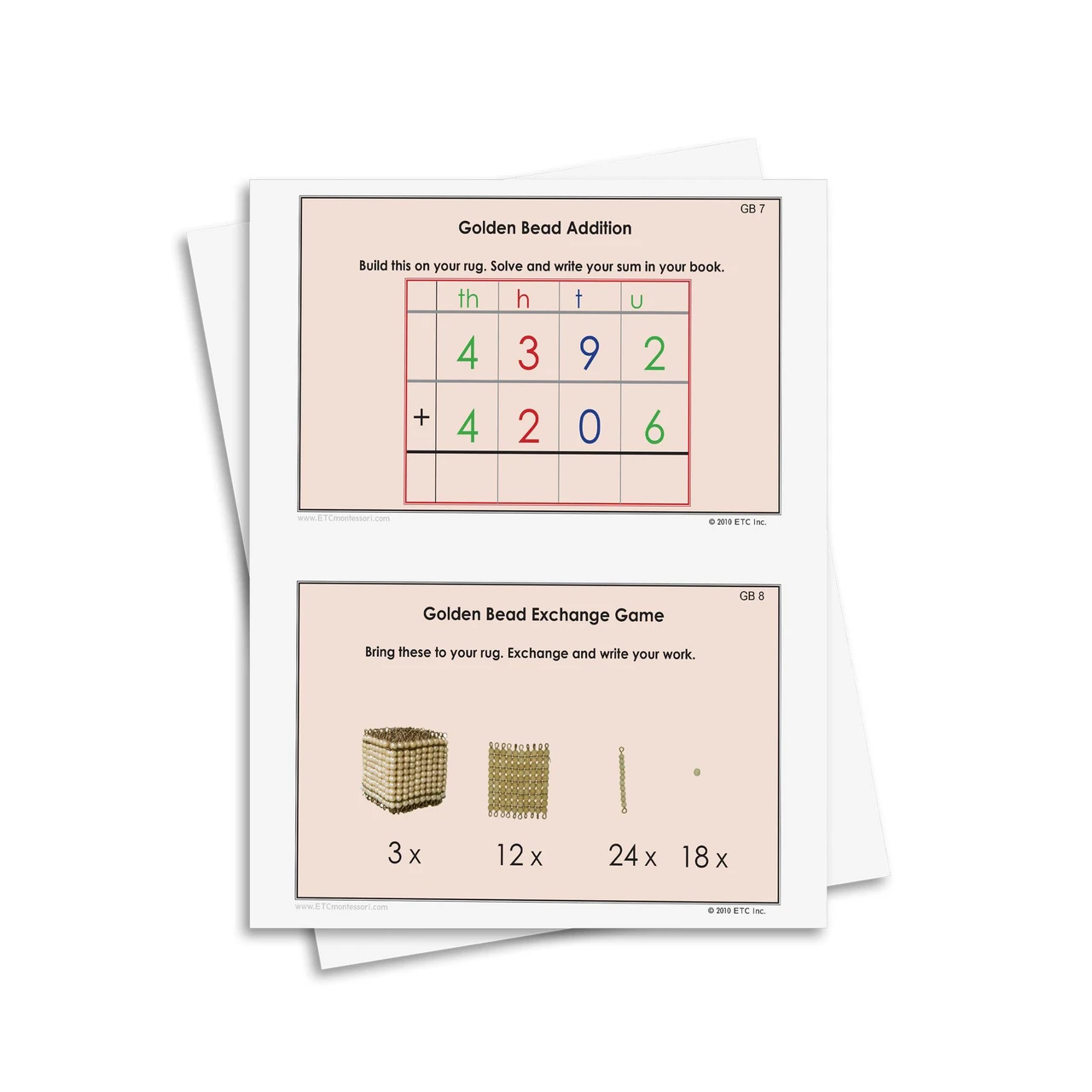
Golden Beads: Develop an understanding of addition using concrete quantities and place value.
-
Exchange Game: Explore how quantities are combined and exchanged within the decimal system.
-
Golden Beads Dynamic: Reinforce addition with exchanging as children work with larger quantities.
-
Stamp Game: Transition toward a more symbolic representation of addition while maintaining a connection to place value.
-
Small Bead Frame: Support increasingly abstract addition calculations.
-
Dot Board: Explore addition and place value through a visual representation of mathematical operations.
Addition Facts
The collection also includes exercises associated with:
-
Object Addition: Explore the combination of quantities using concrete objects.
-
Colored Bead Stair: Investigate number combinations and addition relationships.
-
Addition Strip Board: Recognize addition facts and numerical patterns.
-
Number Line: Visualize addition through movement and number relationships.
-
Snake Game: Explore number combinations and reinforce addition fact understanding.
-
Addition Chart: Develop accuracy and fluency with addition facts.
-
Missing Addends: Strengthen reasoning by determining unknown numbers in addition equations.
-
Several Addends: Extend addition practice through problems involving multiple quantities.
Together, these activities provide a progression from concrete mathematical exploration toward greater accuracy, fluency, and independence.
How Do Montessori Addition Task Cards Work?
One of the distinguishing features of ETC Montessori's mathematics task card series is the connection between traditional Montessori instruction and conventional mathematical language.
The front of each card provides work based on a traditional Montessori mathematics presentation, allowing children to apply concepts using familiar manipulatives.
The back of each card introduces the mathematical language commonly used in state standards and assessments to describe related concepts.
This approach helps children recognize that a mathematical relationship explored with Montessori materials can also be represented through written equations, word problems, and conventional mathematical terminology.
For example, children who begin by combining quantities with Golden Beads gradually learn to represent those same relationships using the Stamp Game, Small Bead Frame, or written addition equations.
The task cards reinforce this progression, helping students connect what they experience physically with what they eventually calculate abstractly.
Why Is Addition Taught With Concrete Montessori Materials?
Montessori mathematics emphasizes understanding before memorization.
Instead of beginning with written equations alone, children first explore how quantities combine through physical materials.
By manipulating numbers concretely, students begin to understand essential concepts such as place value, exchanging, numerical relationships, and the properties of addition.
As their understanding grows, materials such as the Stamp Game, Small Bead Frame, and Dot Board provide opportunities to work with increasingly abstract representations.
Addition fact materials then reinforce numerical relationships through repeated practice, allowing children to recognize patterns and develop mathematical fluency.
The goal is not simply to help children calculate answers, but to help them understand the mathematical relationships behind those answers.
Developing Addition Skills Beyond Memorization
The Lower Elementary Addition Task Cards support several areas of mathematical development.
Number Sense: Understanding quantities and how numbers relate to one another.
Place Value: Recognizing the structure of the decimal system and how quantities are exchanged.
Addition Operations: Investigating how quantities combine and how mathematical operations can be represented.
Math Fact Fluency: Strengthening knowledge of addition facts through repetition and pattern recognition.
Missing Addends: Developing reasoning skills by identifying unknown values in addition equations.
Mathematical Vocabulary: Connecting concrete Montessori presentations with conventional arithmetic language.
Independent Learning: Reinforcing previously introduced concepts through structured follow-up work.
By strengthening conceptual understanding alongside mathematical fluency, the cards help children approach new problems with confidence rather than relying exclusively on memorized procedures.
Connecting Montessori Mathematics With State Standards
Montessori teachers and homeschool parents often wonder how children who learn mathematics through concrete materials will recognize the language used in conventional academic assessments.
The ETC Montessori Math Task Card series helps address this challenge.
Each card connects a traditional Montessori mathematics presentation with the corresponding language commonly encountered in state standards.
This allows children to develop mathematical understanding through hands-on experiences while becoming familiar with the written terminology used in academic assessments.
Designed for grades 1–3, the collection supports standards-aligned mathematical learning while preserving Montessori's concrete-to-abstract instructional approach.
A Practical Resource for Montessori Teachers and Homeschool Parents
For Montessori teachers, the Addition Task Cards provide purposeful follow-up activities after presentations involving Golden Beads, the Stamp Game, Small Bead Frame, Dot Board, and addition fact materials.
They can be incorporated into independent mathematics shelf work, individualized work plans, review activities, and ongoing skill reinforcement.
For homeschool parents, the collection provides a structured way to practice addition without having to create individual exercises for every lesson.
Parents can select activities that correspond to their child's mathematical understanding, allowing children to revisit concepts and develop confidence before progressing to more advanced work.
For school administrators and curriculum coordinators, the collection offers a consistent approach to addition practice while allowing guides to individualize instruction based on student readiness.
Additional Teacher and Student Resources
The product page provides access to complementary resources, including:
-
Operations Teacher's Notes and/or Answer Key
-
Operations Checklist for Students
-
Facts Teacher's Notes and/or Answer Key
-
Facts Checklist for Students
-
The King and His Three Daughters
These supporting materials help educators organize lessons, monitor student progress, and provide meaningful opportunities for independent practice.
Who Is This Material Designed For?
The Lower Elementary Math Task Cards: Addition are ideal for Montessori students ages 6–9, grades 1–3, Montessori classrooms, homeschool mathematics programs, and educators seeking structured addition practice.
The collection is particularly useful for children who have received introductory addition presentations and are ready to reinforce their understanding through independent work with Montessori mathematics materials.
RESOURCES
OPERATIONS: Teacher's Notes and/or Answer Key
The King and His Three Daughters
OPERATIONS: Checklist for Students
FACTS: Teacher's Notes and/or Answer Key