
Product Overview
- Your digital files are available for immediate download after checkout. Each file may be downloaded up to two (2) times using the link provided in your order confirmation. We strongly recommend saving your files to your device and creating a backup copy for future access. Lost files or files that are no longer available for download must be repurchased.
- We offer our digital downloadable materials under two license options:
- an Individual License for individual homeschoolers, and
- Extended License for schools, school districts, co-ops, and multi-family homeschool groups.
- School Districts must purchase the extended license option.
Choosing the correct license helps us keep pricing affordable while also preventing copyright misunderstandings.
Montessori Subtraction Operations and Math Facts for Ages 6–9
A child can learn to subtract numbers. But do they understand what happens when one quantity is taken away from another?
Subtraction becomes meaningful when children can see, touch, and explore the relationships between numbers. Montessori mathematics builds this understanding through concrete materials that allow students to experience mathematical concepts before moving toward abstract calculations.
The ETC Montessori Lower Elementary Math Task Cards: Subtraction provide a collection of 180 printable task cards designed to strengthen subtraction skills through purposeful, hands-on learning.
Created for Montessori Lower Elementary students ages 6–9 (grades 1–3), this resource combines subtraction operations and math facts while connecting traditional Montessori presentations with the mathematical language students encounter in state standards and assessments.
Rather than relying exclusively on memorization or repetitive worksheets, these activities help children investigate quantities, understand mathematical relationships, and develop confidence in their ability to solve subtraction problems independently.
What Is Included in the Subtraction Task Cards?
The collection contains 180 task cards organized into two essential areas of mathematical development: subtraction operations and subtraction facts.
Subtraction Operations
These cards provide follow-up practice connected to traditional Montessori materials:
-
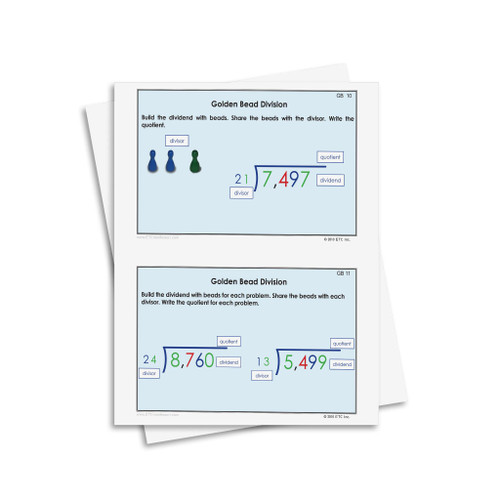
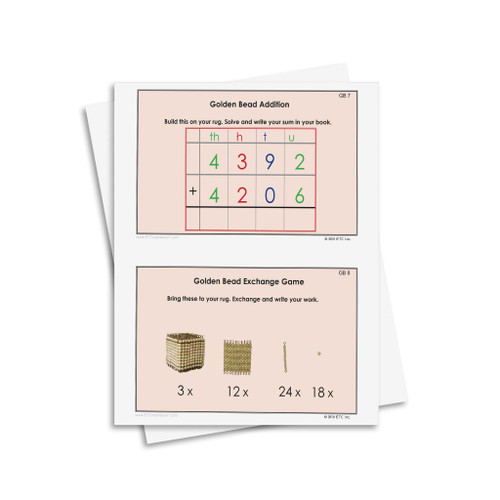
Golden Beads: Reinforce place value and subtraction through concrete quantities.
-
Stamp Game: Help children explore subtraction using a more symbolic representation of the decimal system.
-
Small Bead Frame: Support the transition toward increasingly abstract calculations while maintaining a visual understanding of number relationships.
Subtraction Facts
The collection also includes activities associated with:
-
Object Subtraction: Introduce and reinforce subtraction through concrete objects and quantities.
-
Subtraction Strip Board: Explore numerical differences and subtraction relationships.
-
Number Line: Represent subtraction through movement and numerical distance.
-
Snake Game: Investigate number relationships and reinforce arithmetic understanding.
-
Subtraction Chart: Practice subtraction facts and recognize patterns.
Together, these materials provide a sequence of learning experiences that help children develop both conceptual understanding and mathematical fluency.
How Do Montessori Subtraction Task Cards Work?
The ETC Montessori Math Task Card series connects traditional Montessori instruction with the language used in conventional mathematics.
The front of each task card presents work based on a Montessori mathematical presentation, allowing children to practice concepts using familiar materials.
The back of each card presents related mathematical language commonly found in state standards and academic assessments.
This approach helps students recognize that a subtraction concept explored using concrete materials can also be represented through mathematical symbols, equations, and written questions.
For example, a child may first explore subtraction using Golden Beads to physically remove a quantity from a larger number. With experience, the child begins understanding how that same relationship is expressed through a written subtraction equation.
The task cards help reinforce this connection, supporting the progression from concrete mathematical experiences toward abstract reasoning.
Why Is Subtraction Taught With Montessori Materials?
Montessori mathematics emphasizes understanding before memorization.
When children physically manipulate quantities, they can observe what happens during an operation rather than simply follow a procedure.
Subtraction becomes an investigation of numerical relationships: What quantity did we begin with? How much was removed? What remains? How can we represent the same operation in another way?
The Golden Beads provide a concrete foundation, while materials such as the Stamp Game and Small Bead Frame help children work toward more abstract representations.
As children develop confidence, subtraction fact materials support repeated practice, number pattern recognition, and increasing mathematical fluency.
This progression encourages children to understand why subtraction works, not simply how to produce an answer.
Building Subtraction Skills Beyond Memorization
The Lower Elementary Subtraction Task Cards support important mathematical skills, including:
-
Number Sense: Understanding quantities and the relationships between numbers.
-
Place Value: Recognizing how numbers are organized within the decimal system.
-
Subtraction Operations: Developing an understanding of removing quantities and finding differences.
-
Subtraction Fact Fluency: Strengthening recall through repeated, meaningful practice.
-
Mathematical Reasoning: Connecting concrete experiences with numerical expressions.
-
Problem-Solving: Using familiar Montessori strategies to investigate mathematical questions.
-
Independent Learning: Reinforcing previously introduced concepts through purposeful follow-up work.
The goal is to help children become confident mathematical thinkers who recognize patterns, explain their reasoning, and apply what they have learned.
Connecting Montessori Mathematics With State Standards
One concern shared by Montessori teachers and homeschool parents is whether children who learn mathematics through traditional Montessori materials will recognize the terminology used in conventional academic assessments.
The ETC Montessori Math Task Card series helps address this challenge through its two-sided instructional design.
Children experience subtraction using familiar Montessori presentations and then encounter corresponding mathematical language associated with state standards.
Designed for grades 1–3, the collection helps connect Montessori's concrete-to-abstract approach with conventional expectations for elementary mathematics.
This makes the material particularly useful for educators who want to preserve authentic Montessori instruction while supporting mathematical literacy and assessment readiness.
A Practical Resource for Montessori Teachers and Homeschool Parents
For Montessori teachers, these task cards provide organized follow-up activities after presentations involving Golden Beads, the Stamp Game, Small Bead Frame, and subtraction fact materials.
The cards can be incorporated into independent shelf work, individualized work plans, mathematics practice, review activities, and ongoing skill reinforcement.
For homeschool parents, the collection provides structured subtraction activities without requiring families to develop each exercise independently.
Parents can select cards that correspond to their child's current mathematical understanding and provide additional opportunities for practice before introducing more advanced work.
For school administrators and curriculum coordinators, the collection offers a consistent approach to subtraction practice while allowing teachers to individualize instruction according to each child's readiness.
Additional Teacher and Student Resources
The product page provides links to complementary resources, including:
-
Operations Teacher's Notes and/or Answer Key
-
Operations Checklist for Students
-
Facts Teacher's Notes and/or Answer Key
-
Facts Checklist for Students
-
The King and His Three Daughters
These resources help educators organize lessons, monitor progress, and support independent mathematical work.
Who Is This Material Designed For?
The Lower Elementary Math Task Cards: Subtraction are ideal for Montessori students ages 6–9, grades 1–3, Montessori elementary classrooms, homeschool mathematics programs, and teachers seeking meaningful subtraction practice.
The activities are particularly valuable for children who have received introductory subtraction presentations and are ready to reinforce their understanding through independent work.
RESOURCES
OPERATIONS: Teacher's Notes and/or Answer Key
The King and His Three Daughters
OPERATIONS: Checklist for Students
FACTS: Teacher's Notes and/or Answer Key