

Product Overview
- Your digital files are available for immediate download after checkout. Each file may be downloaded up to two (2) times using the link provided in your order confirmation. We strongly recommend saving your files to your device and creating a backup copy for future access. Lost files or files that are no longer available for download must be repurchased.
- We offer our digital downloadable materials under two license options:
- an Individual License for individual homeschoolers, and
- Extended License for schools, school districts, co-ops, and multi-family homeschool groups.
- School Districts must purchase the extended license option.
Choosing the correct license helps us keep pricing affordable while also preventing copyright misunderstandings.
Montessori Uppercase and Lowercase Letter Matching, Alphabet Recognition, and Early Literacy
Your child recognizes the letter “a.” But what happens when that same letter suddenly looks like “A”?
Learning the alphabet involves more than memorizing 26 letters. Children must also discover that each letter has two commonly used forms: uppercase and lowercase.
Although these forms may look very different, they represent the same letter.
The ETC Montessori Science of Reading: Lower and Upper Case Letter Differentiation activity helps children make this important connection through concrete, picture-supported matching exercises.
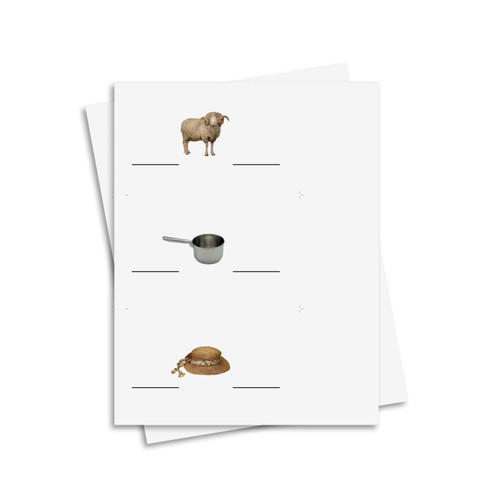
Designed for Montessori Early Childhood students, kindergarten learners, and children developing foundational reading skills, this digital printable resource includes 26 picture cards and separate uppercase and lowercase letter pieces.
Children observe familiar pictures, identify the words they represent, and explore how uppercase and lowercase letters correspond.
Rather than learning capital and small letters as two unrelated sets, children begin recognizing the relationship between the different written forms of the alphabet.
What Is Uppercase and Lowercase Letter Differentiation?
Uppercase and lowercase letter differentiation is the ability to recognize, distinguish, and match the two written forms of the same alphabetic letter.
For example:
A and a represent the same letter.
B and b represent the same letter.
D and d represent the same letter, even though their printed shapes differ.
Some uppercase and lowercase letters look very similar, while others require children to recognize substantially different shapes.
Learning to associate these forms supports alphabet knowledge, letter recognition, and familiarity with written language.
As children begin reading, they encounter lowercase letters in most words and uppercase letters at the beginnings of sentences, in names, and in other conventional uses.
Recognizing both forms helps children identify familiar letters across different reading and writing situations.
What Is Included in the Printable Material?
This 10-page digital PDF includes picture cards and printable letter pieces for the English alphabet.
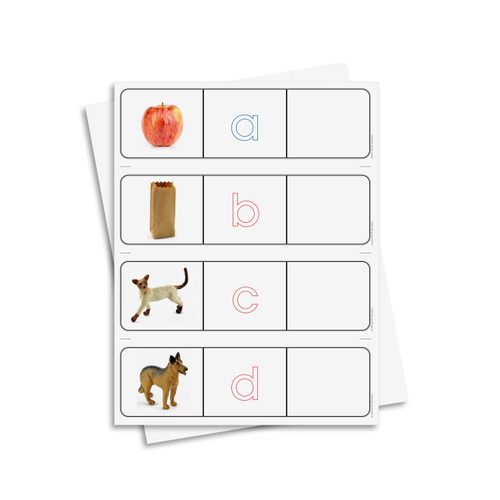
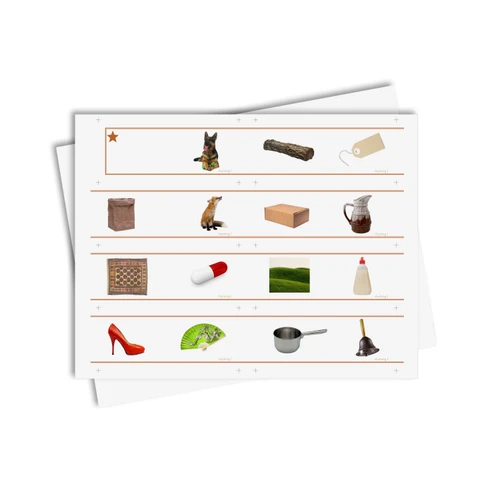
26 Illustrated Picture Cards
The material features realistic pictures representing familiar animals, objects, and everyday vocabulary.
Examples include:
-
Apple
-
Banana
-
Cow
-
Dolphin
-
Elephant
-
Penguin
-
Rabbit
-
Tiger
-
Zebra
Each picture appears on an individual card with space for letter-matching work.
The pictures provide meaningful vocabulary connections that can be used during early alphabet and sound-recognition presentations.
Lowercase Letter Pieces
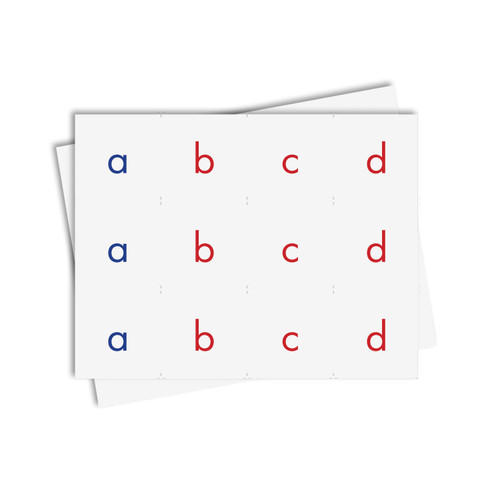
Printable lowercase letters from a to z allow children to identify, select, and match familiar letter forms.
Uppercase Letter Pieces
Separate capital letters from A to Z provide opportunities to recognize the corresponding uppercase forms.
Montessori Color Coding
The printable letter pieces follow the traditional Montessori convention of:
-
Blue vowels: a, e, i, o, u
-
Red consonants: The remaining alphabet letters
This visual distinction helps children recognize different letter categories while working with the alphabet.
The material can be printed, cut, and prepared for repeated matching activities.
How Does the Uppercase and Lowercase Letter Matching Activity Work?
The activity can be introduced through a gradual Montessori presentation.
Step 1: Introduce a Picture
The guide or parent presents a picture card and clearly names the object.
For example, the child sees a picture of an apple.
Step 2: Identify the Beginning Sound
The child listens to the spoken word and identifies its beginning sound.
For apple, the child listens for the initial short /a/ sound.
Step 3: Introduce the Lowercase Letter
The child selects the lowercase letter that represents the identified sound.
The guide reinforces the relationship between the spoken sound and its written symbol.
Step 4: Introduce the Uppercase Form
The guide presents the corresponding uppercase letter.
The child compares a and A, observing their visual differences while recognizing that they represent the same letter.
Step 5: Match the Letter Forms
The child places the corresponding lowercase and uppercase letter pieces with the picture card.
The guide can invite the child to compare the letter shapes and identify their similarities or differences.
Step 6: Repeat With Additional Letters
As the child develops confidence, additional pictures and letters can be introduced.
Children may eventually match uppercase and lowercase letters independently without needing the picture as a reference.
This progression supports familiarity with both letter forms while encouraging observation, comparison, and repetition.
How Does This Activity Support the Science of Reading?
Developing readers need to recognize letters accurately and understand their relationships to spoken sounds.
This material supports that process by strengthening children's knowledge of the different visual forms used to represent the alphabet.
Alphabet Recognition
Children practice identifying individual lowercase and uppercase letters.
Letter-Form Discrimination
Children learn to distinguish letters that may look similar, including pairs such as b and d or p and q.
Uppercase and Lowercase Correspondence
Children recognize that a capital letter and its lowercase counterpart represent the same alphabetic letter.
Letter-Sound Knowledge
When paired with oral sound presentations, the picture cards can reinforce the relationship between familiar words, beginning sounds, and written letters.
Visual Recognition and Recall
Repeated matching helps children become more familiar with the appearance of letters in different forms.
Preparation for Reading and Writing
Recognizing both letter forms supports familiarity with print as children move into word reading, spelling, handwriting, and capitalization.
This activity reinforces alphabet knowledge within a broader, systematic approach to literacy instruction. It is intended to complement, rather than replace, explicit phonics and decoding lessons.
Why Is Uppercase and Lowercase Matching Important?
Children often encounter lowercase letters first through Montessori language activities, including Sandpaper Letters and introductory phonetic work.
As they begin exploring printed books, names, sentences, and written communication, they encounter uppercase letters as well.
Some letter pairs are easy to recognize because their shapes remain similar.
Others, such as A/a, G/g, and R/r, require greater attention to visual differences.
By matching both forms of a letter, children learn to recognize the same alphabetic identity across different printed appearances.
This supports greater familiarity with the letters they encounter during reading and writing.
Why Use This Material in Montessori Education?
Montessori language education emphasizes concrete experiences, careful observation, and a gradual movement toward abstract understanding.
The Lower and Upper Case Letter Differentiation activity supports this progression through realistic pictures and movable letter pieces.
Children can begin with a familiar picture, connect it to a spoken word, and explore the written letters associated with that word.
The matching activity encourages purposeful movement and active participation rather than passive memorization.
It also provides opportunities for repetition, comparison, concentration, and developing independence.
Used alongside Sandpaper Letters, oral sound games, and other Montessori phonics materials, these cards can reinforce children's knowledge of letter forms.
A Practical Resource for Montessori Teachers and Homeschool Parents
For Montessori teachers, the printable provides follow-up activities for alphabet recognition, letter matching, and visual discrimination.
The cards can be incorporated into individual language presentations, small-group activities, independent shelf work, and introductory literacy lessons.
For homeschool parents, the material provides a practical way to help children recognize the relationship between uppercase and lowercase letters.
Parents can begin with a small selection of familiar letters and gradually introduce additional pairs as the child becomes more confident.
For educators supporting developing readers, the cards can provide additional practice for children who recognize one letter form but need help identifying its corresponding capital or lowercase version.
How Does This Material Fit Into the Montessori Reading Sequence?
Uppercase and lowercase letter matching is especially useful once children have begun identifying letters and connecting some of them with their corresponding sounds.
A useful learning progression is:
Recognize spoken sounds → Identify lowercase letters → Match uppercase and lowercase forms → Recognize letters in words → Apply letter knowledge during reading and writing.
This activity provides a bridge between basic alphabet recognition and the increasingly varied letter forms children encounter in printed language.
RESOURCES
Look at the standards that are addressed with this material.