
Product Overview
- Easy cut system requires only 1 cut.
- Printed on Premium Thick card stock.
- Maybe used laminated or unlaminated.
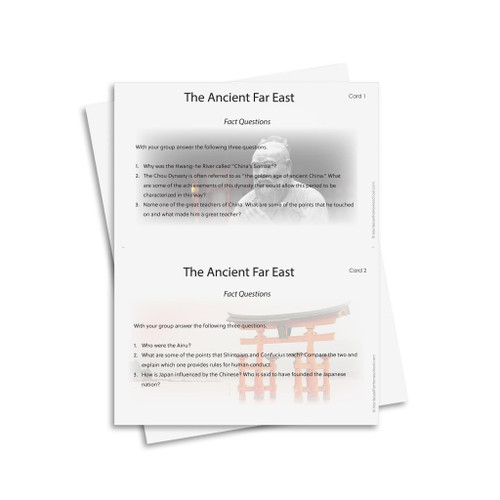
If you want history to feel meaningful—and you want your child to think instead of memorize—Adventures in Ancient Civilizations gives you a complete, ready-to-use set of research prompts that turns ancient history into engaging, project-based learning. Designed for ages 9–12 (Upper Elementary) with a natural bridge into middle school expectations, this resource provides 48 open-ended research questions that guide children to analyze evidence, compare civilizations, and explain cause-and-effect in their own words.
This isn’t a workbook of fill-in-the-blanks. It is a structured “question bank” that helps homeschool students practice the real skills they need for upper-level studies: research, writing, discussion, and deeper thinking. Each prompt invites your child to investigate a topic, form ideas, support them with facts, and communicate clearly—ideal for independent work, family discussions, and multi-week research projects.
What Your Child Will Study: 6 Themed Question Sets
The questions are grouped into themes so you can teach in a clear sequence or let your child choose based on interest:
-
Environment and Geography
How rivers, climate, landforms, and natural disasters shaped where people settled—and how they traveled and navigated. -
Society and Government
Leadership, laws, social classes, fairness, conflict and cooperation, and how communities solved big problems. -
Culture and Beliefs
Myths, religion, art and architecture, education, celebrations, writing systems, and cultural exchange. -
Science, Technology, and Innovation
Engineering and building, math in real life, astronomy and calendars, medicine, inventions, and transportation. -
Economics and Trade
Resources, markets, specialization (jobs), taxes/tribute, trade routes, and how trade spread goods and ideas. -
Legacy and Connections
How ancient ideas still influence the world today, why preserving artifacts matters, and how civilizations affected one another.
Why Homeschool Parents Find This So Effective
It supports independent learning (with real depth)
Your child can select a question, research it, organize notes, and produce a final “work”—without you having to invent assignments. This makes it excellent for work plans, weekly cycles, and project-based learning.
It builds higher-level thinking skills
The prompts are written to push students beyond basic facts. Children are repeatedly asked to:
-
Compare and contrast two civilizations or two solutions to the same problem
-
Analyze cause and effect (What changed? Why? What happened next?)
-
Evaluate choices (Was a leader’s decision fair? What were the trade-offs?)
-
Apply ideas to new situations (What would you recommend? What would you do?)
This aligns naturally with the kinds of thinking expected in middle school research and writing.
It is cross-disciplinary by design
You can treat this as “history,” but it seamlessly connects to other subjects:
-
Reading & Writing (Common Core–aligned skills): research, summarizing, writing explanations and arguments, speaking/listening through presentations or discussions.
-
Science practices (NGSS-style thinking): asking questions, using evidence, explaining how tools and technology solve problems (irrigation, calendars, medicine).
-
Math connections: measurement and design in architecture, estimating time spans on timelines, comparing quantities in trade/resources, using charts and data displays.
-
Geography & map skills: climate regions, river valley systems, trade routes, migration, and settlement patterns.
In other words, one strong research question can become a full week of integrated learning.
Multiple Learning Styles: Easy to Adapt at Home
This set works well whether your child is a strong reader, a builder, an artist, or a talk-it-out learner. You can respond to each question using a format that matches your child:
-
Visual learners: maps, diagrams, labeled drawings, timelines, cause-and-effect charts
-
Hands-on learners: build models (ziggurats, irrigation canals, aqueducts), create artifacts, role-play “advisor to a ruler”
-
Auditory/social learners: discussions, debates, oral storytelling, podcast-style recordings
-
Writing-focused learners: research reports, journal entries (“day in the life”), compare/contrast essays
Practical Ways to Use It in Homeschool
-
Weekly research routine: 1 question per week → reading + notes → one final product (paragraph, poster, model, or short presentation).
-
Unit study backbone: Use it alongside any ancient civilizations spine (textbook, living books, videos). The questions become your project prompts and assessments.
-
Portfolio-friendly outputs: Essays, maps, slides/posters, models, and recorded presentations create strong documentation for homeschool records.
-
Sibling-friendly: Older students can write a multi-paragraph report; younger siblings can draw, narrate orally, or answer with a short paragraph and a labeled picture.
A Strong Bridge into Ancient Civilizations Timelines
These questions intentionally guide children toward the “big drivers” of civilization—food systems, settlement, trade, leadership, technology, belief systems, and cultural exchange—so your student is prepared to study early civilizations (Sumer, Egypt, Indus Valley, early China, and beyond) with real understanding rather than isolated facts.
If you want a resource that helps your child grow into confident research, strong writing, and thoughtful discussion—while learning ancient history in a Montessori-compatible way—Adventures in Ancient Civilizations provides a clear, engaging path.
RESOURCES
Look at our History Flow Chart for Upper Elementary to see how this work fits in with the traditional Montessori history curriculum.
STANDARDS
View the standards that are met through this material.
Download the Teacher's Sample Answers
SUGGESTED CONTAINERS
1 ETC Large Slotted Container
or
1 Acrylic Sorter with 3 Clear Snap Envelopes - Small