

Product Overview
- Your digital files are available for immediate download after checkout. Each file may be downloaded up to two (2) times using the link provided in your order confirmation. We strongly recommend saving your files to your device and creating a backup copy for future access. Lost files or files that are no longer available for download must be repurchased.
- We offer our digital downloadable materials under two license options:
- an Individual License for individual homeschoolers, and
- Extended License for schools, school districts, co-ops, and multi-family homeschool groups.
- School Districts must purchase the extended license option.
Choosing the correct license helps us keep pricing affordable while also preventing copyright misunderstandings.
Montessori Grammar, Sentence Structure, and Logical Analysis
What if children could understand how a sentence works simply by learning which questions to ask?
Understanding grammar involves more than identifying nouns and verbs. Children must also discover how words work together to communicate complete ideas. The Montessori Sentence Analysis Working Chart provides a visual reference that helps students explore these relationships through logical questioning and systematic analysis.
Designed for Montessori Lower Elementary students ages 6–9, this digital printable chart supports the transition from recognizing individual parts of speech to understanding the structure and meaning of complete sentences.
How Does the Montessori Sentence Analysis Working Chart Work?
Montessori sentence analysis uses carefully structured questions to help children identify the function of words and groups of words within a sentence.
Rather than memorizing grammatical definitions in isolation, students learn to investigate the relationships between sentence elements.
The chart provides questions and grammatical terminology for identifying:
-
Predicate: The action or verb at the center of the sentence.
-
Subject: Who or what performs the action.
-
Direct Object: Who or what receives the action.
-
Indirect Object: To whom or for whom the action is directed.
-
Time and Place: When and where an action occurs.
-
Manner and Cause: How or why an action takes place.
-
Purpose and Instrument: What an action is intended to accomplish and what is used to perform it.
-
Additional Sentence Relationships: Agent, source, accompaniment, possession, material, and other grammatical functions.
As children become familiar with these questions, they begin recognizing how sentence elements contribute to meaning.
Why Use a Sentence Analysis Working Chart in Montessori Education?
Montessori grammar moves from concrete experiences toward increasingly abstract language concepts.
Children first explore the functions of individual words through grammar symbols and hands-on materials. Sentence analysis then introduces a deeper level of understanding by examining how those words work together.
The Sentence Analysis Working Chart supports this progression by providing a consistent reference for identifying sentence elements during lessons and independent work.
Through repeated practice, students develop stronger grammatical vocabulary, logical reasoning, reading comprehension, and sentence construction skills.
The chart also encourages students to examine their own writing. By recognizing the function of each sentence element, they can begin to understand how expanding or rearranging language changes meaning.
A Practical Reference for Montessori Teachers and Homeschool Parents
This printable chart can be used during teacher presentations, individual sentence analysis exercises, independent grammar work, and follow-up activities.
It is especially useful alongside Montessori sentence analysis circles and arrows, sentence strips, and the ETC Montessori Sentence Analysis Level 6–9 curriculum.
For teachers, it provides a consistent visual reference that reinforces the terminology used during lessons.
For homeschool parents, it offers a practical way to support sentence analysis work by connecting grammatical terms with the questions children are learning to ask.
What Is Included?
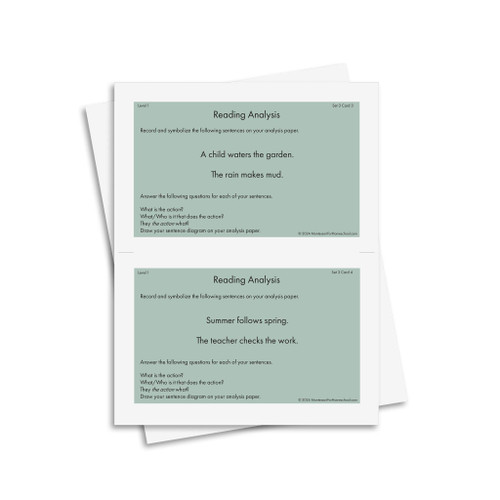
This digital printable resource provides the Montessori Sentence Analysis Working Chart, featuring grammatical terms and guiding questions for identifying the relationships within sentences.
The chart supports the study of subjects, predicates, objects, and additional sentence elements, making it a useful companion to existing Montessori grammar materials.
Please note: This product is a printable working chart, not a complete sentence analysis lesson or task card curriculum. Additional Montessori sentence analysis materials may be used alongside it.
Who Is This Material Designed For?
Ideal for Montessori Lower Elementary classrooms, homeschool language studies, grammar lessons, sentence analysis activities, and independent language shelf work.
Help children move beyond naming parts of speech to understanding how language is organized, how sentences communicate meaning, and how grammar supports effective writing.
Digital Download and Licensing
This product is supplied as a downloadable, printable PDF.
Save the file to your computer after downloading and maintain a backup copy for future access.
Please select the appropriate Individual or Extended License for your intended use and review the digital product terms before purchasing. Digital purchases are non-refundable.
RESOURCES
Look at our Grammar Flow Chart for Lower Elementary to see how this work fits in with the traditional Montessori grammar curriculum.
STANDARDS
View the Standards met through this material.