


Product Overview
- Immediate download of the file after checkout. Files may be downloaded using the link on your invoice twice (2 times) within five (5) days.
- We offer our digital downloadable materials under two license options:
- an Individual License for individual homeschoolers, and
- Extended License for schools, co-ops, and multi-family homeschool groups.
Choosing the correct license helps us keep pricing affordable while also preventing copyright misunderstandings.
The Upper Elementary Geometry Task Cards - Digital Printable is a comprehensive Montessori geometry resource for students ages 9–12. Created to support the upper elementary geometry sequence, this set brings together hands-on exploration, precise vocabulary, geometric reasoning, construction practice, equivalency work, and advanced follow-up activities in one indispensable package.
Upper elementary geometry should be more than naming shapes or memorizing definitions. At this level, students are ready to reason, compare, construct, prove, transform, classify, and explain. This material gives teachers and homeschool parents the tools to guide that work with structure and depth. It helps students revisit familiar Montessori geometry materials with new eyes, moving from earlier sensorial impressions into more exact mathematical thinking.
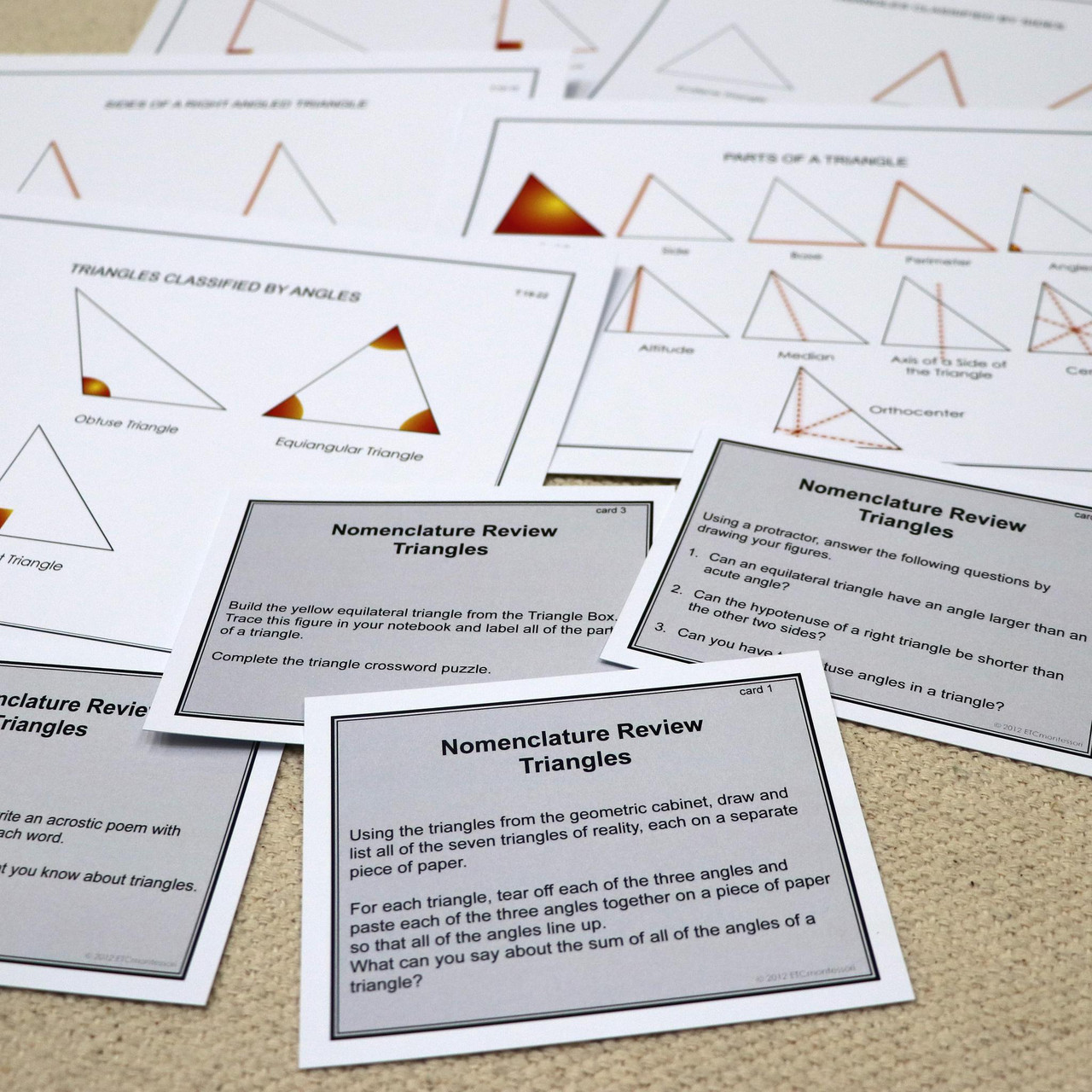
The task cards guide students through a wide range of geometry experiences. They review nomenclature for lines, angles, triangles, quadrilaterals, polygons, and circles. They ask students to use their bodies, classroom materials, rulers, geometric cabinet insets, constructive triangles, geoboards, fraction circles, Polydrons, and notebooks to investigate geometric relationships. This keeps the work active and concrete while encouraging written explanation and independent reasoning.
The set includes extensive work with the Triangle Box, Large Hexagon Box, and Small Hexagon Box, helping students compare figures as congruent, similar, equivalent, or fractional in value. Students build composite shapes, compare relationships among figures, analyze proportion, and record conclusions in their geometry notebooks. These activities strengthen the child’s ability to see geometry as a system of relationships rather than a collection of isolated figures.
The equivalency command cards are especially valuable. Students construct and transform triangles, parallelograms, rhombi, trapezoids, and polygons into rectangles, then analyze the cuts and relationships. This work prepares the mind for area formulas, deductive thinking, and later geometric proof. Instead of simply being told that one figure is equivalent to another, students build the figure, transform it, compare it, and explain the relationship in their own words.
The accompanying Geometric Constructions Student Book adds a powerful layer of precision and abstraction. Students learn to work with a compass and straightedge in the tradition of classical geometry. The workbook begins with rays, lines, and line segments, then moves into constructing equal line segments, copying angles, bisecting angles, constructing perpendicular lines from points on and off a line, constructing triangles by SSS, SAS, and ASA methods, and constructing parallel lines through a point not on a line.
This construction work is beautifully suited to upper elementary students. It requires patience, accuracy, sequencing, and control of movement. It also connects directly to the deeper purpose of Montessori geometry: helping the child discover that mathematical ideas can be constructed, verified, and reasoned through. Students are not only drawing; they are learning how geometric truths are built.
The product includes control charts for basic geometry nomenclature review, along with a student workbook on geometric constructions, a downloadable puzzle book, and a teacher answer key with full-color panels for work with the constructive triangle boxes. This makes the set particularly useful for teachers who want a complete geometry sequence and for homeschool parents who need clear structure, student independence, and reliable follow-up work.
The material also extends into polyhedra and Pythagoras. Students build solids, calculate surface area, use Polydrons, construct solids from geometric cabinet figures, and investigate the Pythagorean theorem through constructive triangle work. They apply the theorem to real-life situations such as houseboat framing, doghouse construction, and determining missing side lengths. These activities help students see that geometry is practical, elegant, and deeply connected to the physical world.
Throughout the set, students are asked to record, illustrate, compare, explain, and prove. They write poems, solve puzzles, draw diagrams, construct figures, measure, classify, transform, and present their reasoning. This variety makes the material engaging for different learning styles while keeping the work grounded in Montessori principles.
For the Montessori guide, this product provides a rich library of follow-up work that can be used after key presentations. For the homeschool parent, it offers a clear path through upper elementary geometry with enough depth to support multiple years of work. For the student, it offers independence, challenge, and the satisfaction of discovering geometric order through hands-on exploration.
The Upper Elementary Geometry Task Cards - Digital Printable is not simply a packet of geometry activities. It is a full upper elementary geometry system—one that supports nomenclature, construction, equivalency, reasoning, proof preparation, geometric vocabulary, and cross-curricular application. It is an essential resource for any Montessori environment that wants students to understand geometry deeply and use it confidently.
What’s Included
This comprehensive digital printable includes:
- Upper elementary geometry task cards.
- Nomenclature review for lines, angles, triangles, quadrilaterals, polygons, and circles.
- Task cards for the Triangle Box.
- Task cards for the Large Hexagon Box.
- Task cards for the Small Hexagon Box.
- Comparison of Triangles from the Constructive Triangles.
- Comparison of Hexagons from the Constructive Triangles.
- Equivalency Commands for triangles.
- Equivalency Commands for parallelograms.
- Equivalency Commands for rhombi.
- Equivalency Commands for polygons.
- Equivalency Commands for trapezoids.
- Polyhedra task cards.
- Pythagoras task cards.
- Control charts for basic geometry nomenclature review.
- Geometric construction student workbook pages.
- Work with rays, lines, line segments, angles, bisectors, perpendiculars, parallels, and triangle constructions.
- Activities using SSS, SAS, and ASA triangle construction methods.
- Geometry nomenclature puzzle support.
- Teacher support resources and answer key materials referenced in the product listing.
RESOURCES
Look at our Upper Elementary Geometry Flow Chart to see how this work fits in with the traditional Montessori geometry curriculum.
Teacher's Notes and/or Answer Key
Crossword Puzzle Book and Answers
The following resource materials are highly recommended:
STANDARDS
View the Standards met through this material.