
Product Overview
- No Lamination Required.
- Printed on Premium Thick Plastic and Cut.
- This material is ready to start using. No other prep work is needed.
If you start with Ancient Civilization research cards (ELC-5092) this research-driven resource takes things to a higher level. Designed to be used as a bridge between the second timeline of early humans (TL-039) and the timeline of ancient civilizations it meets Montessori expectations for independence, depth, and meaningful inquiry. Adventures in Ancient Civilizations is a curated collection of 48 open-ended research questions designed specifically for Montessori ages 9–12, with natural “inroads” into middle school expectations such as evidence-based writing, structured research, and comparative analysis.
Rather than asking students to memorize facts, this material guides them to think like historians, geographers, scientists, and economists. Each prompt is intentionally written to move students beyond “what happened?” into higher-level work: analyzing cause-and-effect, comparing civilizations, evaluating choices leaders made, and connecting ancient innovations to the modern world. It is ideal for research projects, independent work plans, small-group seminars, and cross-curricular presentations.
What’s Included: 6 Themed Research Sets
This resource is organized into clear, classroom-ready categories that support planning and differentiated lessons:
-
Environment and Geography (Set 1): How landforms, rivers, climate, natural disasters, and navigation shaped settlement and survival.
-
Society and Government (Set 2): Leadership systems, laws, social classes, conflict vs. cooperation, and crisis decision-making.
-
Culture and Beliefs (Set 3): Myth, religion, art/architecture, education, festivals, writing systems, and cultural exchange.
-
Science, Technology, and Innovation (Set 4): Engineering, mathematics in daily life, astronomy, medicine, invention, and transportation systems.
-
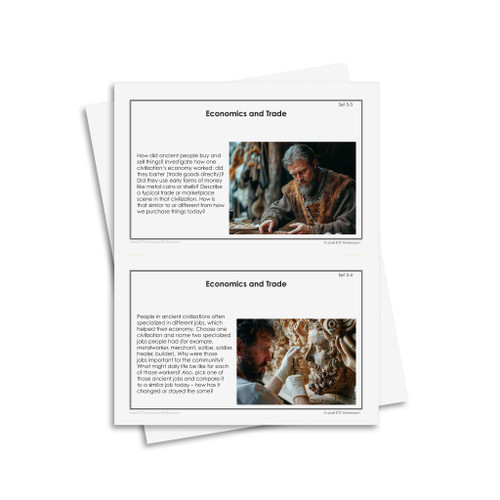
Economics and Trade (Set 5): Resources, specialization, markets, trade routes, taxation/tribute, and how economies shaped power.
-
Legacy and Connections (Set 6): Urban planning, long-term influence of ancient ideas, historical preservation, and how civilizations impacted one another through exchange, war, and migration.
- Teacher's Sample Answer Book available for download only.
Why Montessori Teachers Choose It
Purposeful independence: Students can choose a question, plan research, gather sources, and produce a finished product with minimal teacher scripting—perfect for work cycles and follow-up lessons.
Built-in differentiation: The same question can be answered at multiple levels (short response, paragraph, multi-page report, model + explanation, or presentation), making it easy to meet a mixed readiness group without watering down content.
Cross-disciplinary by design:
-
ELA (Common Core): Informational reading, note-taking, summarizing, opinion/argument writing, and speaking/listening through presentations and debates.
-
Math: Measurement and planning in architecture/engineering, comparing quantities (trade, resources), timelines, and early math applications.
-
Science & NGSS practices: Asking questions, using evidence, building explanations, and examining how technology solves problems (irrigation, aqueducts, calendars, navigation).
-
Social Studies inquiry: Civics, economics, geography, and cultural systems—taught through investigation and comparison rather than textbook recitation.
Multiple learning styles supported:
-
Visual learners: Mapping, diagrams, timelines, and art/architecture studies.
-
Kinesthetic learners: Model-building (structures, irrigation systems), role-play (advisor to a ruler), and hands-on project work.
-
Auditory/social learners: Socratic discussions, group investigations, oral storytelling, and debates.
-
Reading/writing learners: Research reports, journal-style “day in the life” writing, and source-based explanations.
Bridge to the Timeline of Ancient Civilizations
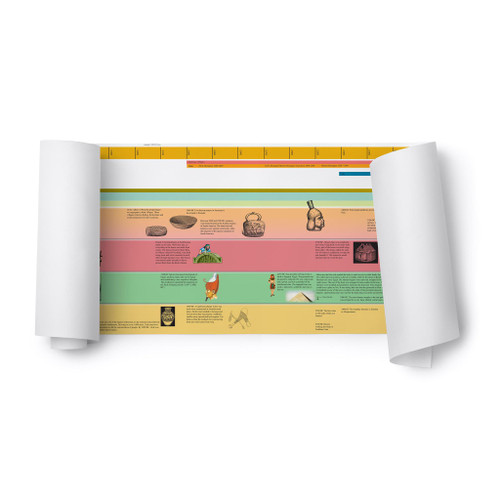
This set is an excellent continuation from early human studies and a strong entry point into formal civilization timelines. The questions repeatedly return to the “big drivers” of civilization—environment, food systems, trade, governance, belief systems, technology, and legacy—so students naturally build the conceptual framework needed to study Sumer, Egypt, the Indus Valley, China, Greece, Rome, and beyond with greater coherence and maturity.
If you want students to produce deeper work products—research papers, multimedia presentations, comparative charts, maps, models, or structured debates—this resource provides the prompts that make that level of thinking routine and achievable in an Upper Elementary Montessori environment.
RESOURCES
Look at our History Flow Chart for Upper Elementary to see how this work fits in with the traditional Montessori history curriculum.
STANDARDS
View the standards that are met through this material.
Download the Teacher's Sample Answers
SUGGESTED CONTAINERS
1 ETC Large Slotted Container
or
1 Acrylic Sorter with 3 Clear Snap Envelopes - Small