

Product Overview
- Immediate download of the file after checkout. Files may be downloaded using the link on your invoice twice (2 times) within five (5) days.
- We offer our digital downloadable materials under two license options:
- an Individual License for individual homeschoolers, and
- Extended License for schools, co-ops, and multi-family homeschool groups.
Choosing the correct license helps us keep pricing affordable while also preventing copyright misunderstandings.
This updated kingdom chart is based on ITIS (Integrated Taxonomic Information System).
Printing Instructions:
- If you are printing this document at home or classroom using a letter size printer please view the file: Instructions for Printing a large scale document using Adobe Acrobat
- If you are printing this document using the resources from your district's regional print center, please provide them with the file you downloaded. No additional work is necessary. Please ensure you have an extended license for this.
| Control Chart | 28.4 x 12 in. | 72 x 30.5 cm. |
| Mute Chart | 28.4 x 12 in. | 72x 30.5 cm. |
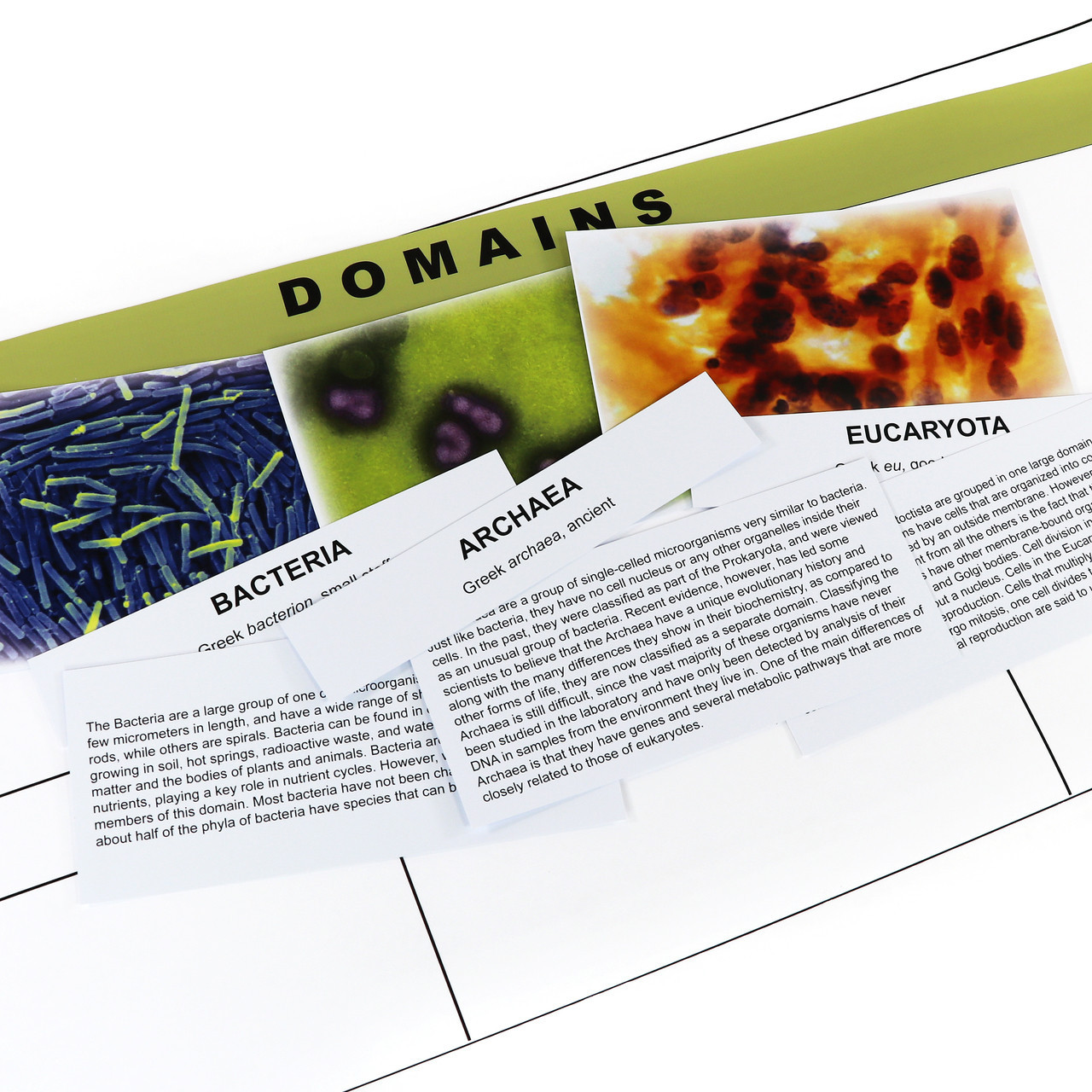
The three-domain classification system is a biological classification system that divides all living organisms into three categories: Bacteria, Archaea, and Eukarya. This system was proposed in the 1990s by the American microbiologist Carl Woese and is based on differences in the structure and function of the cells of organisms. Bacteria and Archaea are both prokaryotic organisms, which means that they lack a nucleus and other membrane-bound organelles. Bacteria are the most well-known and diverse group of prokaryotes and are found in a wide range of environments. Archaea are a group of prokaryotes that are often found in extreme environments, such as hot springs and deep-sea vents. Eukarya, on the other hand, are organisms with a nucleus and other membrane-bound organelles. This category includes all animals, plants, fungi, and protists. The three-domain system is now widely accepted as a major framework for understanding the relationships between all living organisms and has contributed to our understanding of the diversity and evolution of life on Earth.
The Three Domains Chart set comes complete with:
- 1 Control chart.
- 1 Mute chart.
- 3 pictures of representatives for each phylum.
- 3 labels to name each phylum. Each label includes the etymology of the word.
- 3 description cards for each phylum.
Movable pieces come printed on thick plastic, cut and ready to use. This chart may be used by the teachers and schools who teach the five (5) or six (6) kingdom taxonomy. Please note that the hierarchy is as follows:5 Kingdoms:The domains Bacteria and Archaea contain only the Kingdom Prokaryotae.The domain Eukarya contains the Kingdoms:
- Animalia
- Plantae
- Protoctista
- Fungi
6 Kingdoms:The domain Bacteria contains the Kingdom EubacteriaThe domain Archaea contains the Kingdom ArchaeobacteriaThe domain Eukarya contains the following Kingdoms:
- Animalia
- Plantae
- Protoctista
- Fungi
RESOURCES
Look at our Science Flow Chart for Lower Elementary and that for Upper Elementary to see how this work fits in with the traditional Montessori curriculumThe Three Domain Model was originally proposed by Carl Woese in 1990. Beginning in the early 1980 there was a move by some scientists to redefine the kingdoms to be monophyletic groups, groups made up of relatively closely related organisms. Carl Woese took the Prokaryota Kingdom and divided it into two new kingdoms: The Eubacteria Kingdom, and the Archaeobacteria Kingdom. Recently Cavalier and Smith further divided the kingdom Protoctista into two new kingdoms thus proposing the Seven Kingdom Model. However, this new model has not been accepted by many scientists. It is still under debate and additional research is needed before we can accept this new model.
STANDARDS
View the Standards met through this material.