
Product Overview
- Immediate download of the file after checkout
- We offer our digital downloadable materials under two license options:
- an Individual License for individual homeschoolers, and
- Extended License for schools, co-ops, and multi-family homeschool groups.
Choosing the correct license helps us keep pricing affordable while also preventing copyright misunderstandings.
62 pages
The Montessori Upper Elementary Homeschool Plan with Flow Charts & Completion Milestone Charts is an indispensable planning and recordkeeping companion for families, teachers, and homeschool programs working with students ages 9–12. Created to support the fourth, fifth, and sixth levels of the Montessori upper elementary cycle, this resource turns the ETC Montessori flow charts into a practical, usable, and deeply connected homeschool roadmap.
Upper elementary is a remarkable stage of development. Students are no longer simply receiving lessons and repeating materials; they are beginning to reason, compare, question, research, write, revise, calculate, experiment, and present. They are ready for greater responsibility, but they still need structure. They are capable of independence, but they still need guidance. This document provides the bridge between the Montessori sequence and the daily reality of homeschool implementation.
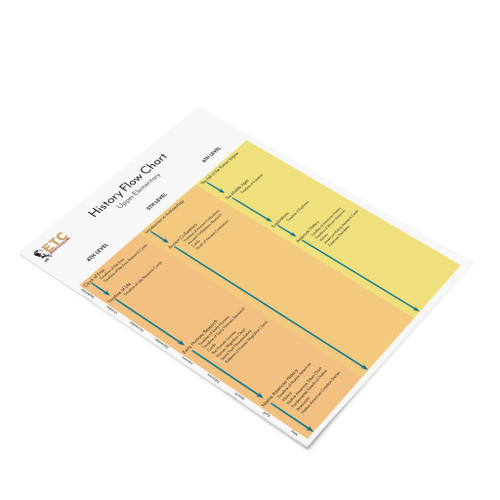
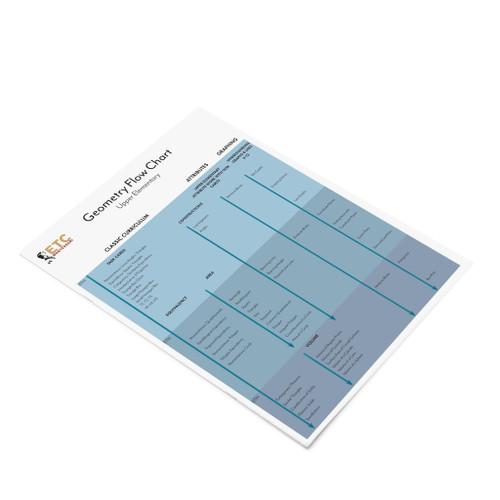
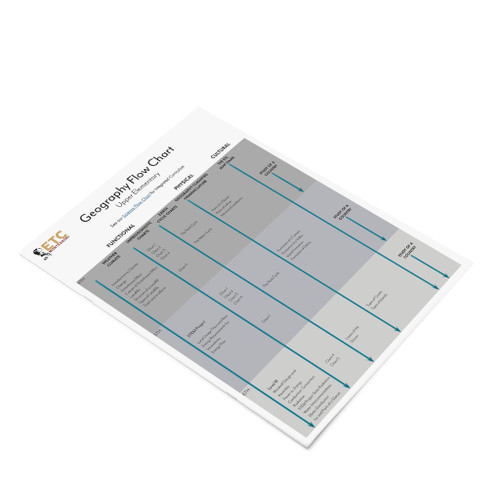
The ETC Montessori flow charts provide the curriculum map. This companion helps parents and teachers travel that map with confidence. It explains how each subject unfolds across the upper elementary years and how the curriculum areas connect to one another. Mathematics becomes a path toward number sense and algebraic reasoning. Language becomes a tool for grammar, word study, mechanics, writing, revision, and publication. Geometry moves from construction and nomenclature into area, graphing, solids, volume, and surface area. History expands into deep time, civilizations, migration, American history, African American history, Native American history, scientists, explorers, and human needs. Geography connects climate, Earth systems, landforms, energy, water, country study, and human responsibility. Science integrates measurement, physical science, chemistry, life science, ecology, classification, cells, genetics, and environmental systems.
This is not a simple checklist. It is a living record of progress.
The included completion milestone charts allow the adult and student to track each lesson through three meaningful stages: presentation, repeated work, and mastery. This structure reflects the Montessori process more accurately than a traditional assignment list. A lesson is not considered complete simply because it was introduced. Students are encouraged to revisit, practice, record, explain, apply, and demonstrate understanding through real evidence.
For homeschool parents, this brings clarity and peace of mind. It answers the essential questions: What should come next? What has already been presented? What still needs repetition? What evidence should be saved? Where is the child ready for more independence? For teachers, it becomes a powerful planning and communication tool. For students, it creates visible ownership. They can help date work, select portfolio evidence, reflect on areas that need practice, and see their growth over time.
The upper elementary years are especially suited to project-based Montessori work, and this resource supports that beautifully. The plan includes guidance for integrated projects such as climate and waste audits, windmill and energy studies, country exhibitions, ancient civilization museums, biome field guides, geometry design projects, human migration atlases, and element or chemistry fairs. These projects help students connect mathematics, language, science, history, geography, and geometry into meaningful work that goes far beyond isolated lessons.
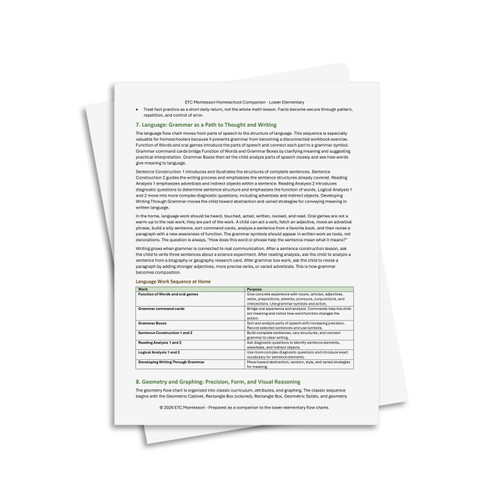
The document also provides practical implementation support for the homeschool environment. It includes guidance for preparing shelves and work areas, organizing notebooks and portfolios, planning the daily and weekly work cycle, designing follow-ups, supporting research and writing, conducting conferences, using fieldwork, adapting to different learners, and assessing readiness. This makes it especially useful for families who want Montessori structure without turning the home into a rigid classroom.
The tone and organization of the resource honor the Montessori method while recognizing the needs of homeschool families. It gives structure without pressure, accountability without rigidity, and documentation without reducing the child’s work to worksheets. It supports freedom with responsibility, independence with guidance, and deep learning with clear records.
What’s Included
This comprehensive upper elementary resource includes:
- A complete Montessori homeschool companion for ages 9–12.
- Guidance for using the ETC Montessori upper elementary flow charts as living curriculum maps.
- Subject-by-subject explanations for Math, Language, Geometry, History, Geography, and Science.
- A three-year upper elementary framework for fourth, fifth, and sixth levels.
- Seasonal and monthly planning guidance.
- Practical support for preparing the homeschool environment.
- Daily and weekly work cycle recommendations.
- Guidance for presentations, follow-ups, abstraction, and meaningful application.
- Recordkeeping and assessment tools.
- Portfolio guidance for authentic documentation.
- Research, writing, and publication support across the curriculum.
- Integrated project suggestions aligned with the flow charts.
- Fieldwork and community connection ideas.
- Support for uneven development and different learning needs.
- Detailed milestone check-off charts for upper elementary progress tracking.
- Balanced completion overviews for fourth, fifth, and sixth levels.
- Subject-specific checklists for Math, Language, Geometry, History, Geography, and Science.
- A structure that allows students to participate actively in documenting their own progress.
Key Benefits
Transforms the flow charts into an actionable homeschool plan
The ETC Montessori upper elementary flow charts provide the sequence. This companion explains how to use that sequence in daily, weekly, monthly, and yearly homeschool planning.
Supports the full ages 9–12 Montessori cycle
Rather than treating fourth, fifth, and sixth levels as isolated years, this resource presents them as a connected three-year arc leading toward independence, abstraction, research, and synthesis.
Builds student responsibility
Upper elementary students are invited to become active participants in their own progress. They can help track lessons, choose portfolio evidence, reflect on repeated work, and prepare for conferences.
Provides clear documentation of mastery
The check-off charts move beyond “done” and help adults record whether a lesson has been presented, practiced, and mastered through explanation, application, written work, project work, or portfolio evidence.
Keeps homeschool parents organized
Parents can see what has been covered, what needs review, what should be saved, and what comes next—without losing sight of the child’s individual pace.
Strengthens teacher-parent-student communication
The charts create a shared language around progress. Everyone can see where the child is in the sequence and what kind of evidence demonstrates understanding.
Encourages meaningful, integrated work
The resource helps families connect subjects naturally through research projects, fieldwork, writing, data collection, geometry applications, science experiments, geography studies, and historical investigations.
Protects the Montessori method
This plan helps prevent the common problem of turning Montessori into worksheets or disconnected assignments. It keeps the focus on presentation, material work, observation, repetition, application, independence, and reflection.