

Product Overview
- Immediate download of the file after checkout. Files may be downloaded using the link on your invoice twice (2 times) within five (5) days.
- We offer our digital downloadable materials under two license options:
- an Individual License for individual homeschoolers, and
- Extended License for schools, co-ops, and multi-family homeschool groups.
Choosing the correct license helps us keep pricing affordable while also preventing copyright misunderstandings.
Timeline of Explorers Research Questions is a complete, cross-curricular unit study designed for homeschool families and co-ops seeking to bring history, science, geography, and literacy to life through meaningful, hands-on exploration. Rooted in a carefully curated timeline of global exploration, this program leads students in grades 4–6 through a vibrant study of humanity’s greatest journeys—across continents, oceans, poles, and even space.
With 51 rich, open-ended research questions grouped by region—North America, South America, Europe, Africa, Asia, Oceania, Antarctica, Ocean, and Space—this curriculum transforms social studies into an engaging, integrative experience that encourages children to think critically, ask questions, explore deeply, and build lasting knowledge.
Designed With Homeschool in Mind:
Flexible Format – Can be adapted for unit studies, morning baskets, co-op group classes, or independent learners.
Parent-Ready – Includes sample answers and teaching prompts so you don’t need to be an expert to guide the learning.
Multi-Age Friendly – Although designed for grades 4–6, many activities are easily adaptable for slightly younger or older students.
Minimal Prep, Maximum Depth – Most materials can be done using common household supplies, library books, and free online resources.
What Makes It Unique:
? Interdisciplinary Approach
This isn’t just history—it’s an integrated learning journey across:
-
Geography – Maps, ecosystems, climates, continents, and regions
-
History & Culture – Global civilizations, indigenous cultures, famous explorers
-
Science – Earth systems, astronomy, environmental change, ecosystems, and adaptation
-
Language Arts – Creative writing, report writing, poetry, and oral storytelling
-
Art & Design – Cartography, model-making, collage, and visual storytelling
? Higher-Level Thinking for Curious Learners
Children are encouraged to:
-
Ask “why” and “how” instead of just memorizing facts
-
Compare perspectives (e.g., explorer vs. indigenous communities)
-
Evaluate motivations and outcomes (e.g., Was this exploration helpful or harmful?)
-
Create their own theories, maps, inventions, and artistic representations
? Hands-On, Multi-Sensory Activities
Each question can be expanded into:
-
A model (ships, landforms, habitats)
-
A drawing, map, or diagram
-
A skit or storytelling presentation
-
A science experiment or ecosystem simulation
-
A journal entry, letter, or newspaper article
?️ Perfect for Co-Op Use
This program works beautifully in co-op settings as:
-
A year-long or semester unit study (weekly regional focus)
-
A thematic supplement to geography or history curriculum
-
A project-based elective course in humanities or world cultures
-
A shared project for multi-age pods or learning communities
What’s Included:
-
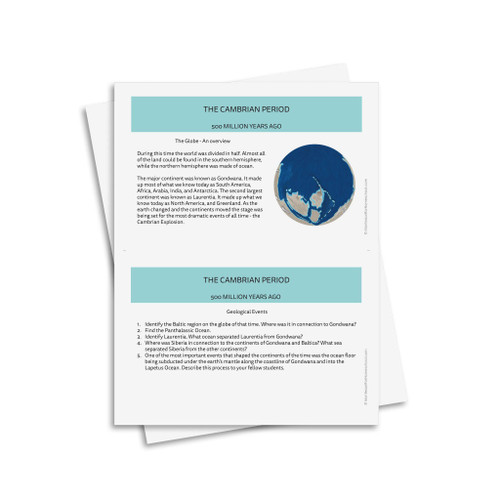
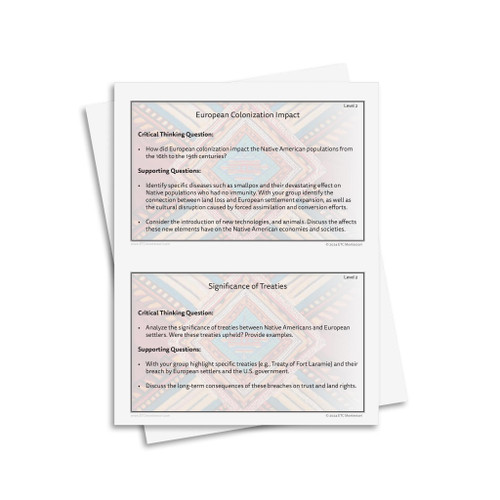
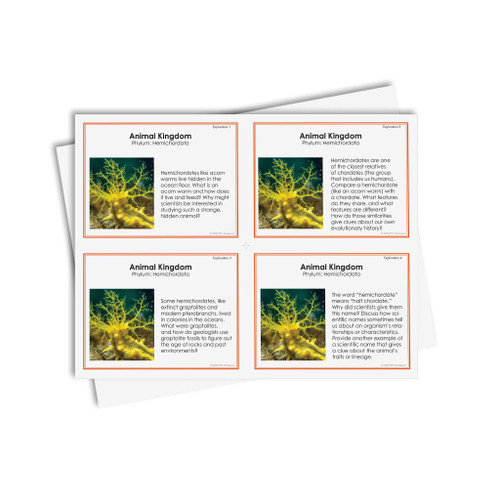
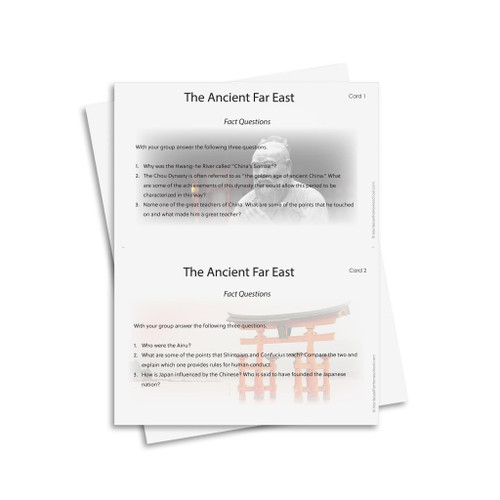
Regional research cards (51 open-ended questions with sample answers)
-
Teacher/parent guide with sample answers, download link
Real Learning, Real Standards:
This material meets and supports:
-
Common Core ELA Standards (Grades 4–6) – through writing, analysis, reading comprehension, and speaking/listening
-
C3 Social Studies Framework – with an emphasis on geography, historical inquiry, and civic perspective
-
Next Generation Science Standards (NGSS) – through Earth systems, life science, environmental impacts, and scientific modeling
All standards are met through authentic, inquiry-driven work—not through worksheets or drills.
Sample Topics Students Will Explore:
-
What dangers did Arctic explorers face, and how did they survive?
-
How did indigenous people shape the success of early European expeditions?
-
What did explorers discover when they looked up to space, or down into the ocean?
-
How did trade, climate, and curiosity connect ancient civilizations?
-
What do modern scientists still learn from the journeys of the past?
Ideal For Homeschoolers Who Want To:
-
Teach multiple subjects through one meaningful theme
-
Encourage independent and creative thinking
-
Dive deeply into history and global awareness
-
Build writing and research skills without a traditional textbook
-
Promote discussion-based learning with siblings or co-op peers
RESOURCES
Teacher's Sample Answer Key
STANDARDS
View the Standards that are met through this material.