

Product Overview
- Immediate download of the file after checkout. Files may be downloaded using the link on your invoice twice (2 times) within five (5) days.
- We offer our digital downloadable materials under two license options:
- an Individual License for individual homeschoolers, and
- Extended License for schools, co-ops, and multi-family homeschool groups.
Choosing the correct license helps us keep pricing affordable while also preventing copyright misunderstandings.
The Understanding Graphs and Their Uses Level 9-12 material is an essential Montessori resource for helping upper elementary students understand graphs as powerful tools for reasoning, prediction, comparison, and communication. Designed for ages 9–12, this digital printable continues naturally from the Level 6–9 graphing work, while also functioning as a complete standalone graphing module for students ready to work with more advanced data and coordinate-based concepts.
At the upper elementary level, graphing is no longer just an introduction to visual data. Students are now ready to ask deeper questions: What does the graph show? What patterns are visible? What can be predicted? Which type of graph best represents this information? What happens when data changes? How do variables relate? How can a graph tell a story? This material helps students answer those questions through a rich combination of vocabulary cards, graph examples, coordinate worksheets, task cards, real-world data activities, and open-ended investigations.
This set presents graphing as a living mathematical language. Students work with bar graphs, pie graphs, line graphs, coordinate graphs, scatter plots, stem-and-leaf plots, histograms, and box plots. They are introduced to the Cartesian coordinate system, quadrants, x-axis, y-axis, origin, coordinates of a point, independent variables, dependent variables, correlation, extrapolation, interpolation, mean, median, mode, and range. These concepts are not presented as isolated definitions. They are connected to practical activities and applied reasoning so students can see how graphs are used to interpret the world around them.
One of the great strengths of this material is the way it connects graphing to beginning algebra and higher-level mathematical thinking. Students plot points, extend linear patterns, predict future values, compare tables and graphs, work across all four quadrants, and use coordinates to map figures and calculate area. Activities inspired by Descartes help students see the relationship between algebra and geometry, giving them a concrete pathway into coordinate graphing and abstract reasoning. This makes the material an excellent bridge between elementary math and the more formal algebraic work students will encounter later.
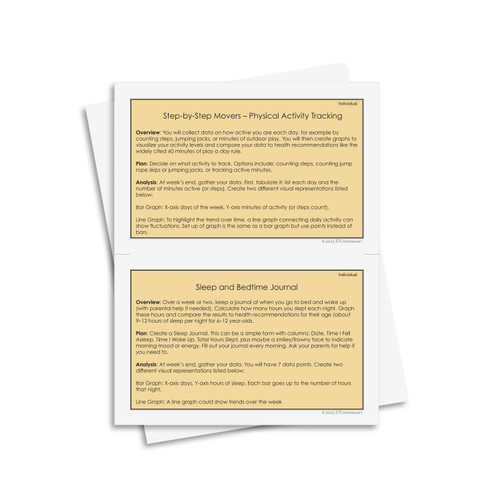
The included graphing activities are practical, varied, and engaging. Students analyze ice cream eating contests, school absences, favorite lunches, book collections, apple production, lunch waste, car values, donations, temperature changes, plant growth, pulse rate, leaking water, viscosity, and heat absorption. They also conduct investigations using classmates’ height and leg span, hand span, ball throws, jumping jacks, homework time, travel time, television watching, and physical experiments. These experiences help students understand that graphs are not artificial school exercises; they are tools used in science, commerce, transportation, sports, medicine, social studies, and everyday decision-making.
The material also encourages students to think critically about data. They are asked to estimate, compare, calculate range, find mean and median, identify mode, notice outliers, evaluate correlation, make predictions, choose which statistic best supports a statement, and explain why one type of graph may be more useful than another. This moves students beyond simply reading a graph into true analysis and interpretation.
Teachers and homeschool parents will appreciate that this set promotes investigative learning. Many of the activities are designed for discussion, collaboration, experimentation, and follow-up. Students are not simply completing a worksheet; they are collecting data, plotting it, interpreting it, comparing results, writing explanations, and sharing conclusions. This approach supports the Montessori principle that children learn deeply when they work with purposeful materials, observe relationships, ask questions, and apply concepts to meaningful situations.
The set also introduces the use of graphing calculators, Excel, and internet-based data sources, making it especially valuable for upper elementary students who are beginning to bridge hands-on Montessori work with modern mathematical tools. Students can use technology to create tables, plot linear graphs, compare real data, and investigate larger data sets while still grounding their understanding in concrete graph interpretation.
For Montessori classrooms, this resource provides strong follow-up work for math, geometry, science, geography, and practical life. For homeschool families, it offers a complete and structured way to teach advanced graphing without reducing the subject to disconnected worksheets. It can be used independently, with a partner, in small groups, or as part of larger research and science projects.
The Understanding Graphs and Their Uses Level 9-12 material is an indispensable tool for upper elementary students who are ready to interpret data, recognize patterns, use coordinates, make predictions, and understand how mathematics helps explain real-world relationships. It helps students see that graphing is not simply a math topic—it is a way of thinking.
What’s Included
This digital printable includes:
- Coordinate grid worksheets and four-quadrant graphing work.
- Cartesian coordinate system vocabulary and visual reference cards.
- Graph vocabulary cards for pie graphs, bar graphs, line graphs, scatter plots, stem-and-leaf plots, histograms, box plots, and coordinate graphing.
- Vocabulary and concept cards for mean, median, mode, range, interpolation, extrapolation, dependent variables, independent variables, and correlation.
- René Descartes and coordinate graphing connection cards.
- Task cards for plotting coordinates and creating pictures on a grid.
- Activities for calculating area using coordinates.
- Graphing stories that ask students to match narrative movement or change to visual graph patterns.
- Bar graph interpretation cards using real-world contexts.
- Line graph activities involving temperature, plant growth, pulse rate, leaking water, viscosity, heat absorption, donations, car value, and real-world trends.
- Scatter plot investigations involving height, leg span, jumping, pencil length, and bounce height.
- Stem-and-leaf plot activities using class data and real measurements.
- Histogram activities using movement, repeated attempts, bouncing balls, and grouped data.
- Box plot activities using QR-code-supported data investigations.
- Activities involving graphing calculators, Excel, and internet-based data research.
- Opportunities for individual, partner, and group work.
- Built-in writing prompts that require students to explain mathematical reasoning.
RESOURCES
Look at our Upper Elementary Math Flow Chart to see how this work fits in with the traditional Montessori math curriculum.
Teacher's Notes. Please note that the graphs and many of the activities in this set of materials are to be performed as group projects/activities and their intention is to generate discussions of how and why. These graphs are meant to promote investigative learning rather than just rote problem solving you would find in worksheets.
Answer Key: Download the answer key. Answer key is being made available strictly online.
Updated pages for Box Plots
STANDARDS
View the Standards met through this material